


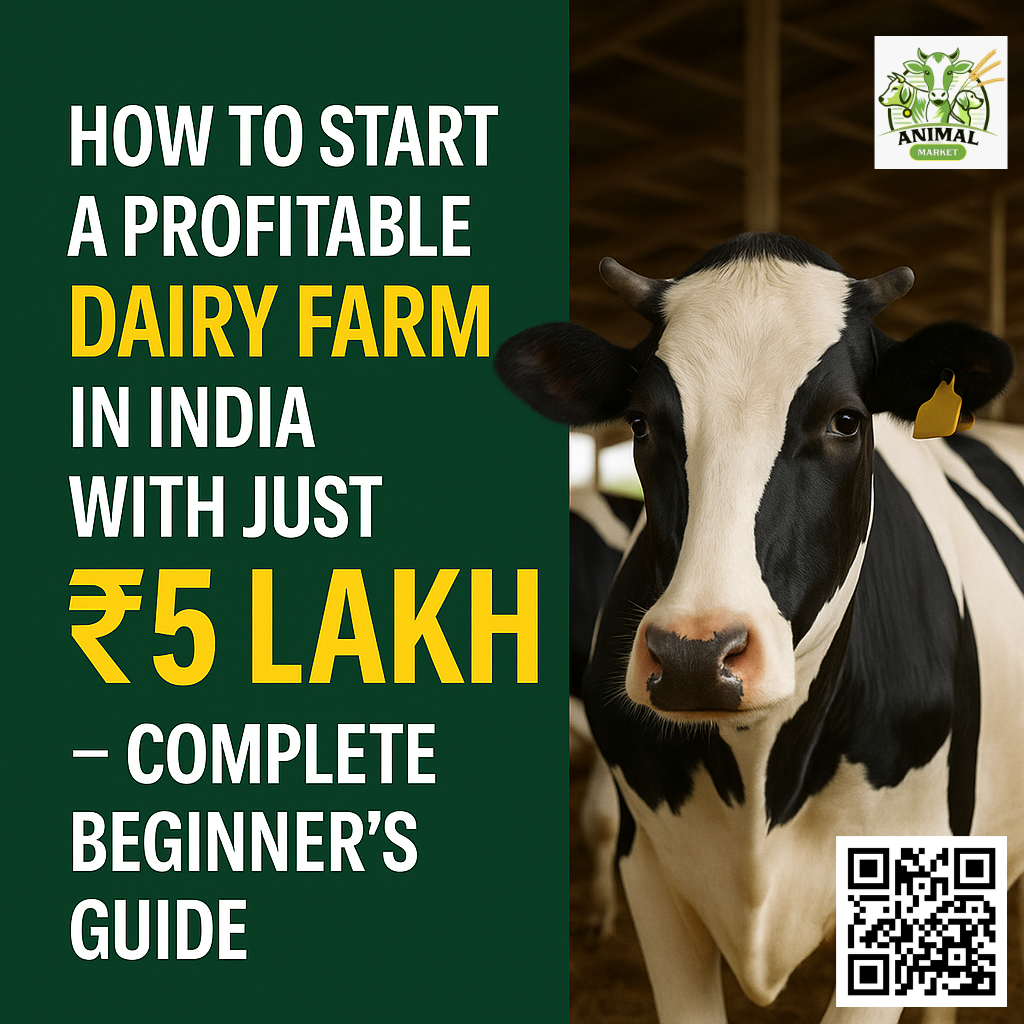
From ₹0 to ₹1 Lakh/Month: How Small Farmers Can Win Big with Dairy Farming with ₹5,00,000 Investment
<p>Dairy farming is more than just milking cows; it’s a scientific, sustainable business that plays a key role in India's rural economy. With increasing demand for milk, paneer, ghee, and curd, small-scale dairy farming can generate steady income and long-term returns for farmers.</p><p>In this blog, we break down everything you need to know—including a practical ₹5 lakh budget plan—to help you start a small-scale dairy farm successfully.</p><hr><h2><strong>1. Dairy Farming Business Model (Small-Scale)</strong></h2><p>For a ₹5 lakh budget, you can follow this business model:</p><ul>
<li>
<p><strong>Number of animals:</strong> 2 milch cows or buffaloes + 1 heifer (young female)</p>
</li>
<li>
<p><strong>Animal type:</strong> Indigenous or crossbred (like HF x Sahiwal)</p>
</li>
<li>
<p><strong>Land requirement:</strong> 0.5 to 1 acre (owned or leased)</p>
</li>
<li>
<p><strong>Milk yield target:</strong> 8–12 liters/day per cow</p>
</li>
</ul><hr><h2><strong>2. Selecting the Right Breeds</strong></h2><table>
<thead>
<tr>
<th>Breed</th>
<th>Milk Yield (per day)</th>
<th>Lactation Period</th>
<th>Remarks</th>
</tr>
</thead>
<tbody>
<tr>
<td>Sahiwal</td>
<td>10–12 liters</td>
<td>270–300 days</td>
<td>Heat-tolerant, ideal for North India</td>
</tr>
<tr>
<td>Gir</td>
<td>8–10 liters</td>
<td>250–300 days</td>
<td>Hardy and disease-resistant</td>
</tr>
<tr>
<td>HF Cross</td>
<td>12–15 liters</td>
<td>280–320 days</td>
<td>Needs better nutrition and care</td>
</tr>
<tr>
<td>Murrah (buffalo)</td>
<td>10–12 liters</td>
<td>300 days</td>
<td>Rich milk fat (~7%)</td>
</tr>
</tbody>
</table><p><strong>Tip:</strong> Buy animals from certified farms, local animal fairs, or government livestock centers.</p><hr><h2><strong>3. Housing and Shed Requirements</strong></h2><p>A proper shed ensures comfort, hygiene, and productivity.</p><h3><strong>Shed Features:</strong></h3><ul>
<li>
<p><strong>Floor:</strong> Cemented, non-slippery, sloped for drainage.</p>
</li>
<li>
<p><strong>Roof:</strong> Asbestos/tin/thatched depending on climate.</p>
</li>
<li>
<p><strong>Ventilation:</strong> Natural airflow with 10–12 ft height.</p>
</li>
<li>
<p><strong>Space:</strong> 50 sq. ft per cow (covered) + open paddock area.</p>
</li>
</ul><p><strong>Approximate Cost for 2–3 animals:</strong> ₹60,000 – ₹75,000<br>
Includes feeding trough, water system, boundary, and dung pit.</p><hr><h2><strong>4. Feeding & Fodder Planning</strong></h2><p>Feeding accounts for 60–70% of your recurring costs. Balanced feeding increases milk yield and animal health.</p><h3><strong>Feed Components:</strong></h3><ul>
<li>
<p><strong>Green fodder:</strong> Napier grass, maize, berseem.</p>
</li>
<li>
<p><strong>Dry fodder:</strong> Paddy straw, wheat straw.</p>
</li>
<li>
<p><strong>Concentrates:</strong> Cotton seed cake, bran, mineral mix.</p>
</li>
<li>
<p><strong>Silage:</strong> Fermented green fodder (can be stored for 6 months).</p>
</li>
</ul><h3><strong>Daily Feed per Cow (approx.):</strong></h3><table>
<thead>
<tr>
<th>Feed Type</th>
<th>Quantity</th>
</tr>
</thead>
<tbody>
<tr>
<td>Green fodder</td>
<td>20–25 kg</td>
</tr>
<tr>
<td>Dry fodder</td>
<td>5–6 kg</td>
</tr>
<tr>
<td>Concentrate</td>
<td>2–4 kg</td>
</tr>
<tr>
<td>Water</td>
<td>50–70 liters</td>
</tr>
</tbody>
</table><p><strong>Tip:</strong> Grow your own fodder on leased land to save costs.</p><hr><h2><strong>5. Milking and Hygiene Practices</strong></h2><ul>
<li>
<p>Milk cows twice daily at fixed times.</p>
</li>
<li>
<p>Use full-hand milking method, not finger milking.</p>
</li>
<li>
<p>Keep udder and teats clean before and after milking.</p>
</li>
<li>
<p>Use stainless steel cans, strainers, and buckets.</p>
</li>
<li>
<p>Clean and sanitize utensils daily.</p>
</li>
</ul><h3>Equipment Required:</h3><table>
<thead>
<tr>
<th>Equipment</th>
<th>Estimated Cost</th>
</tr>
</thead>
<tbody>
<tr>
<td>Aluminum milk cans (10L)</td>
<td>₹1,200 x 2 = ₹2,400</td>
</tr>
<tr>
<td>Steel buckets, mugs</td>
<td>₹1,000</td>
</tr>
<tr>
<td>Rope, brush, first aid kit</td>
<td>₹1,500</td>
</tr>
</tbody>
</table><hr><h2><strong>6. Veterinary Care & Insurance</strong></h2><ul>
<li>
<p><strong>Vaccination schedule:</strong> FMD, HS, BQ every 6–12 months.</p>
</li>
<li>
<p><strong>Deworming:</strong> Every 3 months.</p>
</li>
<li>
<p><strong>AI (Artificial Insemination):</strong> After calving (~60–90 days).</p>
</li>
<li>
<p><strong>Insurance:</strong> Highly recommended (₹300–₹400/year per cow).</p>
</li>
</ul><p>Tie up with a local veterinary officer or dairy co-op for routine checks.</p><hr><h2><strong>7. Budget Plan – ₹5,00,000 Dairy Farm (2 Cows Model)</strong></h2><table>
<thead>
<tr>
<th>Category</th>
<th>Description</th>
<th>Cost (₹)</th>
</tr>
</thead>
<tbody>
<tr>
<td><strong>Cattle Purchase</strong></td>
<td>2 cows (HF/Sahiwal cross), ₹75,000 each</td>
<td>₹1,50,000</td>
</tr>
<tr>
<td><strong>Shed Construction</strong></td>
<td>Covered area, water system, dung pit</td>
<td>₹70,000</td>
</tr>
<tr>
<td><strong>Feed (6 months)</strong></td>
<td>Green + dry fodder + concentrates</td>
<td>₹60,000</td>
</tr>
<tr>
<td><strong>Fodder Cultivation Setup</strong></td>
<td>Lease land + seeds + irrigation</td>
<td>₹30,000</td>
</tr>
<tr>
<td><strong>Milking Equipment</strong></td>
<td>Milk cans, buckets, rope, brushes</td>
<td>₹5,000</td>
</tr>
<tr>
<td><strong>Veterinary Care & Insurance</strong></td>
<td>Vaccination, AI, 1-year insurance</td>
<td>₹5,000</td>
</tr>
<tr>
<td><strong>Heifer/Calf Purchase</strong></td>
<td>For future expansion</td>
<td>₹30,000</td>
</tr>
<tr>
<td><strong>Labor/Helper (if needed)</strong></td>
<td>1 part-time helper for 6 months</td>
<td>₹30,000</td>
</tr>
<tr>
<td><strong>Miscellaneous & Reserve</strong></td>
<td>Transport, emergencies, medicine</td>
<td>₹20,000</td>
</tr>
</tbody>
</table><h3><strong>Total Estimated Cost:</strong> ₹4,99,000</h3><p><strong>(You can also start with 1 cow + 1 heifer if budget is tight.)</strong></p><hr><h2><strong>8. Monthly Income & Expenses (Estimation)</strong></h2><p>Assume: 2 cows yield 20 liters/day @ ₹35/liter (local rate)</p><table>
<thead>
<tr>
<th>Income/Expense</th>
<th>Amount (₹)</th>
</tr>
</thead>
<tbody>
<tr>
<td><strong>Milk Sales (600 L/month)</strong></td>
<td>₹21,000</td>
</tr>
<tr>
<td><strong>Feed & Care</strong></td>
<td>₹8,000</td>
</tr>
<tr>
<td><strong>Labor (if any)</strong></td>
<td>₹5,000</td>
</tr>
<tr>
<td><strong>Veterinary & Misc.</strong></td>
<td>₹1,500</td>
</tr>
<tr>
<td><strong>Net Profit (monthly)</strong></td>
<td>₹6,500+</td>
</tr>
</tbody>
</table><p><strong>Annual Net Income:</strong> ₹75,000–₹1,00,000 (can increase as heifer matures)</p><hr><h2><strong>9. Government Subsidies & Loan Assistance</strong></h2><p>Apply through:</p><ul>
<li>
<p><strong>NABARD Dairy Entrepreneurship Development Scheme (DEDS)</strong></p>
</li>
<li>
<p><strong>State Animal Husbandry Department</strong></p>
</li>
<li>
<p><strong>Kisan Credit Card (KCC)</strong></p>
</li>
<li>
<p><strong>PM Fasal Bima Yojana (if you grow fodder)</strong></p>
</li>
</ul><h3>Subsidy Support:</h3><ul>
<li>
<p>25–33% for SC/ST/Women/General category.</p>
</li>
<li>
<p>Apply via cooperative banks or District Veterinary Officer.</p>
</li>
</ul><hr><h2><strong>10. How to Sell Milk Profitably?</strong></h2><ul>
<li>
<p><strong>Local sales:</strong> Households, tea shops, small hotels.</p>
</li>
<li>
<p><strong>Bulk buyers:</strong> Dairies, sweet shops.</p>
</li>
<li>
<p><strong>Value-added:</strong> Sell paneer, ghee, buttermilk for more margin.</p>
</li>
<li>
<p><strong>Digital selling:</strong> Use WhatsApp or local apps.</p>
</li>
</ul><hr><h2><strong>11. Real Success Stories (Examples)</strong></h2><ol></ol><p></p><ol></ol>
<ol>
</ol><ol></ol>
<ol><li><strong>Ravi Singh (Uttar Pradesh):</strong> Started with 2 cows, now runs a 10-cow dairy farm, sells organic milk in town for ₹50/liter.</li><li><strong>Pushpa Devi (Rajasthan):</strong> Self-help group leader, earns ₹40,000/month through dairy + manure sales.</li><li><strong>Sunil Kumar (Andhra Pradesh):</strong> Uses cow dung to make vermi compost and earns extra ₹20,000/year.</li>
</ol><hr><h2><strong>12. Final Tips for New Dairy Farmers</strong></h2><ul>
<li>
<p>Start small, grow gradually.</p>
</li>
<li>
<p>Maintain daily records (milk, feed, health).</p>
</li>
<li>
<p>Focus on animal comfort, hygiene, and vaccination.</p>
</li>
<li>
<p>Build local customer trust through clean, quality milk.</p>
</li>
<li>
<p>Keep reserve funds for emergencies.</p>
</li>
</ul><hr><h2><strong>Conclusion</strong></h2><p>Dairy farming with a ₹5 lakh investment is not only practical but profitable for Indian farmers. With the right planning, animals, and dedication, it can provide year-round income and improve rural livelihoods.</p>
Open PDF
<li>
<p><strong>Number of animals:</strong> 2 milch cows or buffaloes + 1 heifer (young female)</p>
</li>
<li>
<p><strong>Animal type:</strong> Indigenous or crossbred (like HF x Sahiwal)</p>
</li>
<li>
<p><strong>Land requirement:</strong> 0.5 to 1 acre (owned or leased)</p>
</li>
<li>
<p><strong>Milk yield target:</strong> 8–12 liters/day per cow</p>
</li>
</ul><hr><h2><strong>2. Selecting the Right Breeds</strong></h2><table>
<thead>
<tr>
<th>Breed</th>
<th>Milk Yield (per day)</th>
<th>Lactation Period</th>
<th>Remarks</th>
</tr>
</thead>
<tbody>
<tr>
<td>Sahiwal</td>
<td>10–12 liters</td>
<td>270–300 days</td>
<td>Heat-tolerant, ideal for North India</td>
</tr>
<tr>
<td>Gir</td>
<td>8–10 liters</td>
<td>250–300 days</td>
<td>Hardy and disease-resistant</td>
</tr>
<tr>
<td>HF Cross</td>
<td>12–15 liters</td>
<td>280–320 days</td>
<td>Needs better nutrition and care</td>
</tr>
<tr>
<td>Murrah (buffalo)</td>
<td>10–12 liters</td>
<td>300 days</td>
<td>Rich milk fat (~7%)</td>
</tr>
</tbody>
</table><p><strong>Tip:</strong> Buy animals from certified farms, local animal fairs, or government livestock centers.</p><hr><h2><strong>3. Housing and Shed Requirements</strong></h2><p>A proper shed ensures comfort, hygiene, and productivity.</p><h3><strong>Shed Features:</strong></h3><ul>
<li>
<p><strong>Floor:</strong> Cemented, non-slippery, sloped for drainage.</p>
</li>
<li>
<p><strong>Roof:</strong> Asbestos/tin/thatched depending on climate.</p>
</li>
<li>
<p><strong>Ventilation:</strong> Natural airflow with 10–12 ft height.</p>
</li>
<li>
<p><strong>Space:</strong> 50 sq. ft per cow (covered) + open paddock area.</p>
</li>
</ul><p><strong>Approximate Cost for 2–3 animals:</strong> ₹60,000 – ₹75,000<br>
Includes feeding trough, water system, boundary, and dung pit.</p><hr><h2><strong>4. Feeding & Fodder Planning</strong></h2><p>Feeding accounts for 60–70% of your recurring costs. Balanced feeding increases milk yield and animal health.</p><h3><strong>Feed Components:</strong></h3><ul>
<li>
<p><strong>Green fodder:</strong> Napier grass, maize, berseem.</p>
</li>
<li>
<p><strong>Dry fodder:</strong> Paddy straw, wheat straw.</p>
</li>
<li>
<p><strong>Concentrates:</strong> Cotton seed cake, bran, mineral mix.</p>
</li>
<li>
<p><strong>Silage:</strong> Fermented green fodder (can be stored for 6 months).</p>
</li>
</ul><h3><strong>Daily Feed per Cow (approx.):</strong></h3><table>
<thead>
<tr>
<th>Feed Type</th>
<th>Quantity</th>
</tr>
</thead>
<tbody>
<tr>
<td>Green fodder</td>
<td>20–25 kg</td>
</tr>
<tr>
<td>Dry fodder</td>
<td>5–6 kg</td>
</tr>
<tr>
<td>Concentrate</td>
<td>2–4 kg</td>
</tr>
<tr>
<td>Water</td>
<td>50–70 liters</td>
</tr>
</tbody>
</table><p><strong>Tip:</strong> Grow your own fodder on leased land to save costs.</p><hr><h2><strong>5. Milking and Hygiene Practices</strong></h2><ul>
<li>
<p>Milk cows twice daily at fixed times.</p>
</li>
<li>
<p>Use full-hand milking method, not finger milking.</p>
</li>
<li>
<p>Keep udder and teats clean before and after milking.</p>
</li>
<li>
<p>Use stainless steel cans, strainers, and buckets.</p>
</li>
<li>
<p>Clean and sanitize utensils daily.</p>
</li>
</ul><h3>Equipment Required:</h3><table>
<thead>
<tr>
<th>Equipment</th>
<th>Estimated Cost</th>
</tr>
</thead>
<tbody>
<tr>
<td>Aluminum milk cans (10L)</td>
<td>₹1,200 x 2 = ₹2,400</td>
</tr>
<tr>
<td>Steel buckets, mugs</td>
<td>₹1,000</td>
</tr>
<tr>
<td>Rope, brush, first aid kit</td>
<td>₹1,500</td>
</tr>
</tbody>
</table><hr><h2><strong>6. Veterinary Care & Insurance</strong></h2><ul>
<li>
<p><strong>Vaccination schedule:</strong> FMD, HS, BQ every 6–12 months.</p>
</li>
<li>
<p><strong>Deworming:</strong> Every 3 months.</p>
</li>
<li>
<p><strong>AI (Artificial Insemination):</strong> After calving (~60–90 days).</p>
</li>
<li>
<p><strong>Insurance:</strong> Highly recommended (₹300–₹400/year per cow).</p>
</li>
</ul><p>Tie up with a local veterinary officer or dairy co-op for routine checks.</p><hr><h2><strong>7. Budget Plan – ₹5,00,000 Dairy Farm (2 Cows Model)</strong></h2><table>
<thead>
<tr>
<th>Category</th>
<th>Description</th>
<th>Cost (₹)</th>
</tr>
</thead>
<tbody>
<tr>
<td><strong>Cattle Purchase</strong></td>
<td>2 cows (HF/Sahiwal cross), ₹75,000 each</td>
<td>₹1,50,000</td>
</tr>
<tr>
<td><strong>Shed Construction</strong></td>
<td>Covered area, water system, dung pit</td>
<td>₹70,000</td>
</tr>
<tr>
<td><strong>Feed (6 months)</strong></td>
<td>Green + dry fodder + concentrates</td>
<td>₹60,000</td>
</tr>
<tr>
<td><strong>Fodder Cultivation Setup</strong></td>
<td>Lease land + seeds + irrigation</td>
<td>₹30,000</td>
</tr>
<tr>
<td><strong>Milking Equipment</strong></td>
<td>Milk cans, buckets, rope, brushes</td>
<td>₹5,000</td>
</tr>
<tr>
<td><strong>Veterinary Care & Insurance</strong></td>
<td>Vaccination, AI, 1-year insurance</td>
<td>₹5,000</td>
</tr>
<tr>
<td><strong>Heifer/Calf Purchase</strong></td>
<td>For future expansion</td>
<td>₹30,000</td>
</tr>
<tr>
<td><strong>Labor/Helper (if needed)</strong></td>
<td>1 part-time helper for 6 months</td>
<td>₹30,000</td>
</tr>
<tr>
<td><strong>Miscellaneous & Reserve</strong></td>
<td>Transport, emergencies, medicine</td>
<td>₹20,000</td>
</tr>
</tbody>
</table><h3><strong>Total Estimated Cost:</strong> ₹4,99,000</h3><p><strong>(You can also start with 1 cow + 1 heifer if budget is tight.)</strong></p><hr><h2><strong>8. Monthly Income & Expenses (Estimation)</strong></h2><p>Assume: 2 cows yield 20 liters/day @ ₹35/liter (local rate)</p><table>
<thead>
<tr>
<th>Income/Expense</th>
<th>Amount (₹)</th>
</tr>
</thead>
<tbody>
<tr>
<td><strong>Milk Sales (600 L/month)</strong></td>
<td>₹21,000</td>
</tr>
<tr>
<td><strong>Feed & Care</strong></td>
<td>₹8,000</td>
</tr>
<tr>
<td><strong>Labor (if any)</strong></td>
<td>₹5,000</td>
</tr>
<tr>
<td><strong>Veterinary & Misc.</strong></td>
<td>₹1,500</td>
</tr>
<tr>
<td><strong>Net Profit (monthly)</strong></td>
<td>₹6,500+</td>
</tr>
</tbody>
</table><p><strong>Annual Net Income:</strong> ₹75,000–₹1,00,000 (can increase as heifer matures)</p><hr><h2><strong>9. Government Subsidies & Loan Assistance</strong></h2><p>Apply through:</p><ul>
<li>
<p><strong>NABARD Dairy Entrepreneurship Development Scheme (DEDS)</strong></p>
</li>
<li>
<p><strong>State Animal Husbandry Department</strong></p>
</li>
<li>
<p><strong>Kisan Credit Card (KCC)</strong></p>
</li>
<li>
<p><strong>PM Fasal Bima Yojana (if you grow fodder)</strong></p>
</li>
</ul><h3>Subsidy Support:</h3><ul>
<li>
<p>25–33% for SC/ST/Women/General category.</p>
</li>
<li>
<p>Apply via cooperative banks or District Veterinary Officer.</p>
</li>
</ul><hr><h2><strong>10. How to Sell Milk Profitably?</strong></h2><ul>
<li>
<p><strong>Local sales:</strong> Households, tea shops, small hotels.</p>
</li>
<li>
<p><strong>Bulk buyers:</strong> Dairies, sweet shops.</p>
</li>
<li>
<p><strong>Value-added:</strong> Sell paneer, ghee, buttermilk for more margin.</p>
</li>
<li>
<p><strong>Digital selling:</strong> Use WhatsApp or local apps.</p>
</li>
</ul><hr><h2><strong>11. Real Success Stories (Examples)</strong></h2><ol></ol><p></p><ol></ol>
<ol>
</ol><ol></ol>
<ol><li><strong>Ravi Singh (Uttar Pradesh):</strong> Started with 2 cows, now runs a 10-cow dairy farm, sells organic milk in town for ₹50/liter.</li><li><strong>Pushpa Devi (Rajasthan):</strong> Self-help group leader, earns ₹40,000/month through dairy + manure sales.</li><li><strong>Sunil Kumar (Andhra Pradesh):</strong> Uses cow dung to make vermi compost and earns extra ₹20,000/year.</li>
</ol><hr><h2><strong>12. Final Tips for New Dairy Farmers</strong></h2><ul>
<li>
<p>Start small, grow gradually.</p>
</li>
<li>
<p>Maintain daily records (milk, feed, health).</p>
</li>
<li>
<p>Focus on animal comfort, hygiene, and vaccination.</p>
</li>
<li>
<p>Build local customer trust through clean, quality milk.</p>
</li>
<li>
<p>Keep reserve funds for emergencies.</p>
</li>
</ul><hr><h2><strong>Conclusion</strong></h2><p>Dairy farming with a ₹5 lakh investment is not only practical but profitable for Indian farmers. With the right planning, animals, and dedication, it can provide year-round income and improve rural livelihoods.</p>